



Biospeleology CollectionInstitute of Speleology "Emil Racoviță"
Cave-dwelling biological material collected from Romania and from exotic regions around the world — a working scientific collection, a reference resource for subterranean fauna research
A working collection with heritage value
The scientific collection of the Biospeleology and Karst Edaphobiology Department is a working scientific collection (not a museum collection) and comprises both exotic biological material — collected or donated by ISER researchers or external collaborators from Cuba, Venezuela, Kenya, Mozambique and the Palaearctic region (Turkey, Mallorca, various European countries) — as well as an extensive body of biological material collected within Romania.
The collection totals 12,387 tubes of material preserved in alcohol and 3,591 slide-mount microscope preparations, together with 438 troglobitic beetle specimens pinned dry.
The preserved material belongs to 11 classes of invertebrates, kept either wet (in ethyl alcohol), as fixed slide-mount microscope preparations, or dry on pins, in the case of beetles.
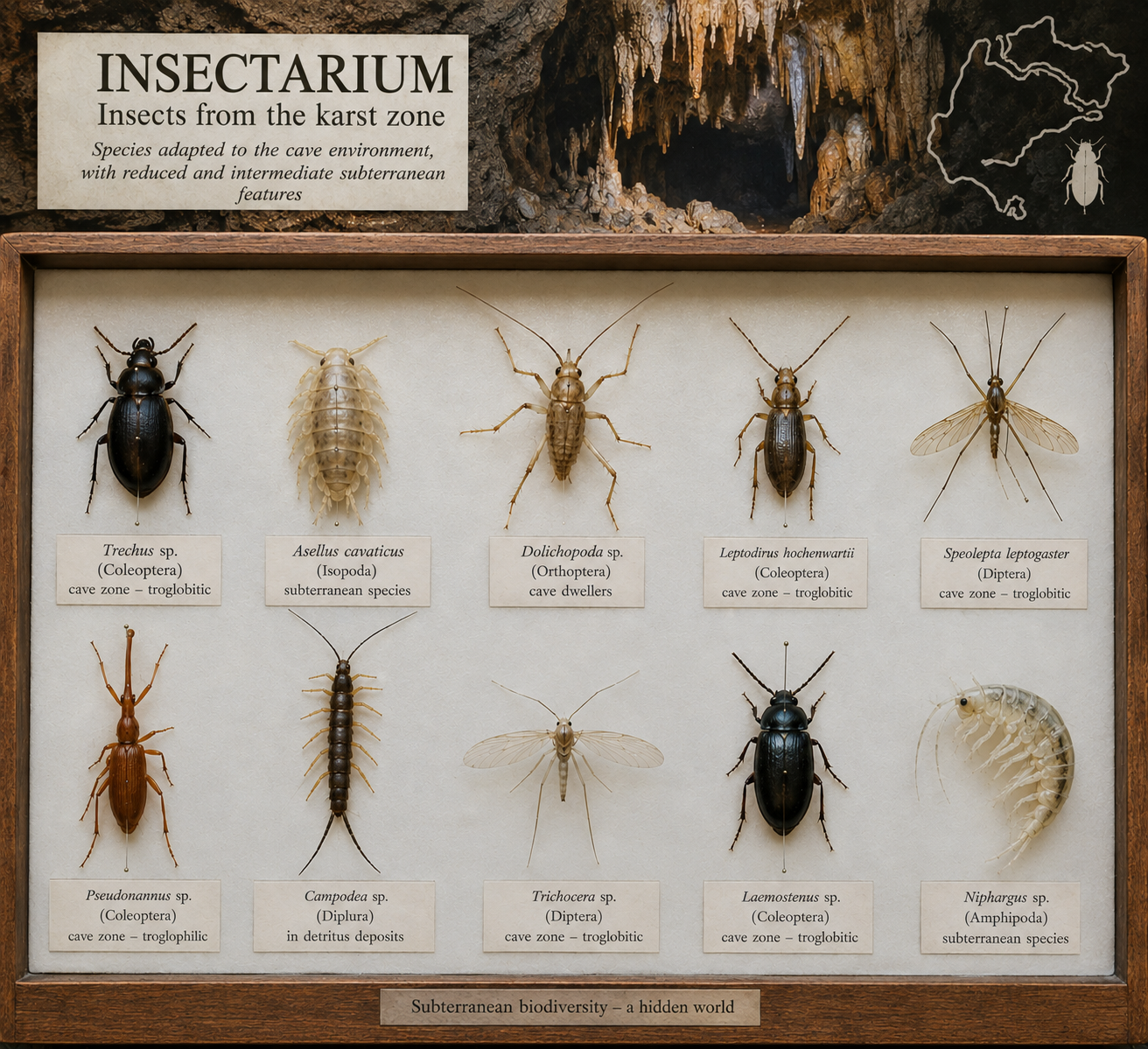
Cave-dwelling biological material preserved in the Biospeleology Department's collection
Taxonomic groups in the collection
A brief overview of the preserved material, listed alphabetically by invertebrate taxonomic group.
Cave-dwelling mites preserved in tubes and microscope preparations.
75 tubes + 1,192 slidesCave-dwelling spiders, preserved wet in alcohol-filled tubes.
584 tubesSmall stygobitic crustaceans from phreatic and interstitial waters.
112 tubes + 1,927 slidesThe most numerous group in the collection, with extensive material from Romanian caves.
5,059 tubes + 385 slidesCave-dwelling springtails, collected from numerous karst sites.
943 tubes + 62 slidesEyeless hexapods, typical of the subterranean environment.
139 tubesTerrestrial and aquatic cave-dwelling molluscs from the ISER collection.
1,409 tubesMixed collection of cave-dwelling terrestrial isopods and millipedes.
2,130 tubes + 13 slidesThe best-represented group by number of type specimens.
1,338 tubesA rare group of subterranean arachnids, preserved exclusively on slides.
12 slidesTroglobitic and troglophilic/trogloxenic species, prepared dry on pins.
438 troglobitic + 500 troglophilic/trogloxenicMaterial collected from outside Romania, alongside the collection initiated by Emil Racoviță himself.
200 tubes + 459 "Biospeologica" tubesType specimens in the collection
Of particular heritage importance are the type specimens in the collection — the specimens from which species new to science were described. The status of type specimens in the ISER collection is set out below.
| Group | Preservation form | Holotypes | Allotypes | Paratypes | Syntypes | Neotypes | Topotypes | Cotypes | Total types |
|---|---|---|---|---|---|---|---|---|---|
| Oniscidea | wet | 2 | 2 | 15 | 0 | 0 | 0 | 1 | 20 |
| Oniscidea | slide | 1 | 0 | 12 | 0 | 0 | 0 | 0 | 13 |
| Diplopoda | wet | 5 | 1 | 10 | 0 | 0 | 0 | 0 | 16 |
| Coleoptera | dry | 1 | 0 | 1 | 0 | 0 | 2 | 1 | 5 |
| Collembola | slide | 23 | 0 | 22 | 0 | 0 | 0 | 0 | 45 |
| Bathynellacea | slide | 19 | 3 | 0 | 0 | 0 | 0 | 3 | 25 |
| Gastropoda | wet | 5 | 0 | 65 | 0 | 0 | 0 | 0 | 70 |
| Chilopoda | slide | 5 | 1 | 0 | 0 | 0 | 0 | 0 | 6 |
| Chilopoda | wet | 13 | 3 | 55 | 3 | 0 | 0 | 0 | 74 |
| Opiliones | wet | 35 | 16 | 102 | 11 | 0 | 0 | 0 | 164 |
| Acaria | slide | 8 | 3 | 57 | 0 | 0 | 0 | 0 | 68 |
| Hydracarina | slide | 0 | 0 | 0 | 0 | 0 | 0 | 40 | 40 |
| Aranea | wet | 2 | 2 | 1 | 0 | 1 | 3 | 0 | 9 |
| TOTAL | — | 118 | 31 | 339 | 14 | 1 | 3 | 44 | 550 |
Status of objects with heritage value
The scientific collection of the Biospeleology and Karst Edaphobiology Department is a working scientific collection (not a museum collection) and comprises both exotic biological material (collected or donated by various ISER researchers or external collaborators) from Cuba, Venezuela, Kenya, Mozambique, the Palaearctic region (Turkey, Mallorca, various European countries), as well as an extensive body of biological material collected within Romania.
To give a brief overview of the heritage value of the scientific material preserved in the ISER collection, it should be noted that it includes specimens preserved wet (in ethyl alcohol) and as fixed slide-mount microscope preparations or dry on pins (Coleoptera), belonging to 11 classes of invertebrates, with a total of 12,387 tubes of material preserved in alcohol and 3,591 slide-mount microscope preparations, together with the 438 troglobitic beetle specimens pinned dry.
The material preserved is distributed as follows (listed alphabetically):
1) Acarina: 75 tubes + 1,192 slide-mount preparations
2) Araneae: 584 tubes
3) Bathynellida: 112 tubes + 1,927 slide-mount preparations
4) Chilopoda: 5,059 tubes + 385 slides
5) Collembola: 943 tubes + 62 slides
6) Diplura: 139 tubes
7) Gastropoda: 1,409 tubes
8) Isopoda + Diplopoda (mixed collection): 2,130 tubes + 13 slides
9) Opiliones: 1,338 tubes
10) Palpigradia: 12 slides
11) Coleoptera: 438 dry preparations (troglobitic species) + 500 preparations of troglophilic/trogloxenic species
In addition to this material, biological material collected from outside Romania (200 tubes) and the especially important "Biospeologica" collection, initiated by Emil Racoviță himself (459 tubes with diverse troglobitic material).
Of particular heritage importance are the type specimens in the collection (specimens from which species new to science were described).
Visit the ISER Collections
The biospeleology, mineralogy and palaeontology collections are available to researchers and visitors at the Bucharest headquarters.

Lily
Here to help! 🦇